
Labor Distribution: Bridging the Gap Between Payroll and General Ledger
Your DCAA auditor traced September labor costs from contract invoices backward through job costing to general ledger to payroll registers to approved timesheets—and discovered that timesheet hours totaled 8,240 for the month while payroll processed 8,460 hours and general ledger recorded $486,000 in labor costs that didn’t reconcile to either source. The 220-hour discrepancy, combined with dollar variances suggesting unapproved timesheet modifications or manual payroll adjustments, led DCAA to question $127,000 in labor charges and cite significant accounting system deficiencies preventing reliable cost accumulation. Here’s what contractors miss about labor distribution: approved timesheets must flow through payroll processing to general ledger posting to contract job costing without unexplained variances, manual adjustments, or reconciliation gaps—any disconnection between these systems suggests that billed labor costs don’t reliably represent actual effort, that controls failed preventing unauthorized changes, or that integration problems created the cost accumulation errors invalidating your entire labor charging methodology. Understanding how to establish, maintain, and verify labor distribution integrity across timekeeping, payroll, and accounting systems isn’t about complex integration technology—it’s about ensuring data consistency through automated interfaces, systematic reconciliation procedures, documented adjustment protocols, and audit trail preservation proving that labor costs flow accurately from source timesheets through financial systems to contract billing without manipulation or unexplained variance.
The Legal Framework Governing Labor Distribution System Integration
Federal cost accounting regulations require contractors to maintain integrated accounting systems ensuring labor cost accuracy from initial time recording through contract billing. FAR 31.201-2(d) mandates adequate accounting systems for accumulating and billing costs, with adequacy encompassing integrated processes where labor distribution originates from approved timesheets, flows through payroll calculations, posts to general ledger accounts, and accumulates in contract job costing without data integrity failures creating unexplained variances. Integration inadequacy—systems requiring manual intervention, producing inconsistent results, or lacking clear audit trails—represents fundamental accounting system deficiency regardless of individual component adequacy.
The cost accumulation requirements under DFARS 252.242-7006(c)(1) specify that accounting systems must provide logical and consistent accumulation of costs between timekeeping and general ledger. This means timesheet hours must equal payroll hours which must match general ledger labor charges which must reconcile to job costing totals, with any variances explained through documented, authorized adjustments rather than unexplained gaps suggesting system failures or unauthorized manipulation. Understanding DCAA compliance requirements means recognizing that labor distribution integrity depends on end-to-end system integration producing consistent, traceable results across all accounting components.
Cost Accounting Standard 407 governs use of standard costs for direct material and direct labor, requiring contractors using standard costs to maintain records of variances and adjust standard to actual costs for contract charging. While most small contractors use actual costing rather than standard costs, CAS 407 principles emphasize that any variance between timesheet labor and billed labor requires documentation, analysis, and appropriate treatment ensuring government contracts aren’t charged for costs not actually incurred or conversely denied proper cost recovery through unexplained reductions. Variance analysis becomes critical compliance requirement even for actual cost systems when integration issues create timesheet-to-billing discrepancies.
The audit trail requirement under FAR 52.215-2 requires contractors to provide access to records supporting contract costs, including complete documentation showing how labor costs flow from timesheets through accounting systems to contract billing. This necessitates comprehensive audit trails demonstrating: timesheet approval and date stamps, payroll processing with approved timesheet references, general ledger posting with payroll batch identifications, and job costing accumulation with general ledger account cross-references. When these audit trails break—when you cannot trace billed costs back to approved timesheets through documented system flows—you’ve created the documentation gaps preventing DCAA verification of cost accuracy and reliability.
What Contractors Must Understand About Labor Distribution Integration Challenges
Here’s what contractors miss about labor distribution: buying integrated software packages from reputable vendors doesn’t guarantee integration operates correctly—you need proper configuration, systematic reconciliation, documented adjustment procedures, and ongoing monitoring ensuring data flows accurately without unexplained variances accumulating into material system deficiencies. DCAA compliance explained emphasizes that integration adequacy depends on operational effectiveness, not just technical capability or vendor promises about system functionality.
The timing mismatch problem emerges when timekeeping, payroll, and general ledger operate on different processing cycles creating temporary discrepancies that become permanent when not properly reconciled. This is where audits go sideways—timesheets approved weekly flow to payroll processing bi-weekly which posts to general ledger monthly, creating timing gaps where labor costs in different systems reflect different periods depending on audit observation dates. When DCAA examines September costs and finds timesheet totals don’t match general ledger amounts because some timesheets processed in October payroll, you’ve created the apparent variance requiring extensive reconciliation explaining timing differences rather than cost errors. While timing variances are explainable, they complicate audits and create documentation burdens that real-time integration would eliminate.
The manual adjustment weakness surfaces when accounting staff make payroll or general ledger adjustments correcting errors, implementing allocation changes, or addressing employee issues without maintaining adequate supporting documentation or approval evidence. Your payroll administrator correcting miskeyed hours, your accountant reclassifying labor between direct and indirect categories, or your controller adjusting fringe benefit allocations might perform legitimate corrections—but without documented authorization, explanatory notation, and audit trail preservation, these adjustments appear as unauthorized cost manipulation when DCAA discovers them during transaction testing. DCAA timekeeping requirements extend beyond timesheet recording to encompass all labor cost processing, with adjustment controls preventing unauthorized changes representing critical accounting system adequacy requirements.
The integration failure gap appears when automated interfaces between timekeeping and payroll or between payroll and general ledger malfunction, producing incomplete data transfers, calculation errors, or transmission failures that accounting staff address through manual intervention creating the lack of automation that integration should provide. When your timesheet-to-payroll interface fails transferring approved hours, staff manually enter payroll from timesheet printouts—immediately creating reconciliation problems when manual entry errors introduce discrepancies between timesheet records and payroll processing. These workarounds might maintain payroll operations but undermine cost accounting integrity through manual intervention introducing errors that automated integration would prevent.
The chart of accounts mapping problem creates integration challenges when timesheet charge codes don’t align perfectly with general ledger account structures or job costing project codes, requiring translation or manual intervention during cost posting. Your timekeeping system might use contract-based charge codes while general ledger requires functional cost type codes and job costing needs project phase identifiers—forcing accounting staff to translate codes during posting or using crosswalk tables requiring maintenance and creating error opportunities. When code translation errors misallocate labor costs to wrong accounts or projects, the resulting mischarging creates the cost accuracy problems that integration should prevent rather than introduce.
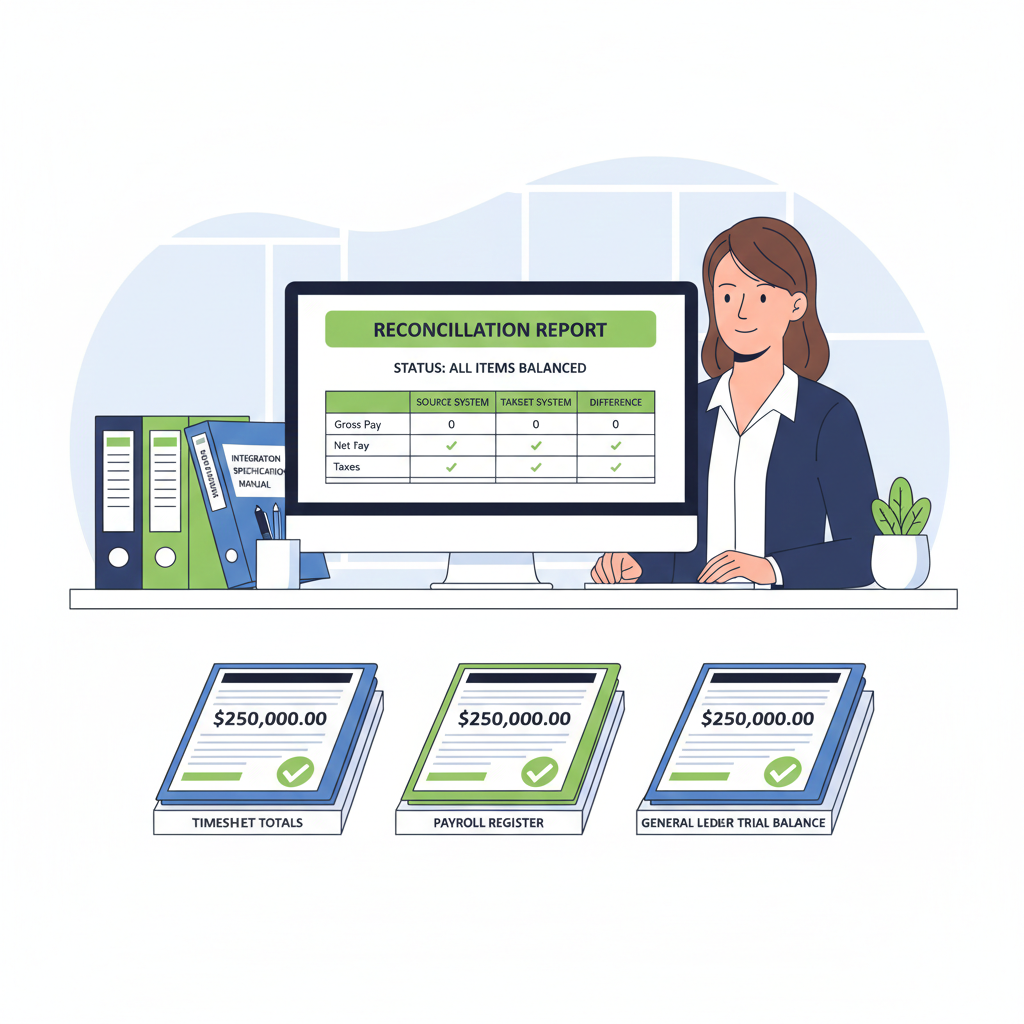
The reconciliation neglect issue emerges when contractors lack systematic procedures verifying that timesheet hours equal payroll hours equal general ledger dollars equal job costing totals, allowing variances to accumulate undetected until external audits reveal systematic discrepancies. Monthly reconciliation disciplines—comparing timesheet totals to payroll hours, validating general ledger labor costs match payroll amounts, and confirming job costing accumulations reconcile to general ledger postings—detect integration failures early when correction remains feasible. Absent systematic reconciliation, problems accumulate across months or years, creating the material discrepancies that DCAA discovers during annual audits when historical reconstruction becomes difficult and expensive.
The fringe benefit allocation disconnect appears when payroll calculates fringe benefits (healthcare, retirement, payroll taxes) but allocation to contracts or indirect pools occurs separately with potential inconsistencies. Your payroll processes $100,000 in gross wages with $28,000 in fringes, but general ledger posts labor at $100,000 and separately allocates fringes through indirect rate calculations potentially using different bases or including different cost elements. When fringe allocation methodologies don’t align with payroll calculations, variances emerge creating the reconciliation challenges and potential cost recovery gaps that integrated fringe treatment would prevent.
Five Essential Steps for Labor Distribution Integration and Reconciliation
Step 1: Establish Automated Integration with Comprehensive Audit Trail Preservation
Implement automated interfaces transferring approved timesheet data to payroll processing without manual intervention, with integration capturing all required elements including employee identification, charge codes, hours by day, approval evidence, and authorization dates. Configure integration to operate real-time or on synchronized schedules minimizing timing variances, with automated validation rejecting incomplete or invalid data requiring correction before processing continues. This automation eliminates manual data entry errors while creating consistent audit trails showing data flow from timekeeping through payroll.
Deploy automated payroll-to-general-ledger posting transferring labor costs with detailed transaction references linking general ledger entries to specific payroll batches, time periods, and employee groups. Configure posting to maintain granular detail supporting cost verification rather than summary entries lacking supporting detail, enabling DCAA auditors to trace general ledger amounts back through payroll to originating timesheets without extensive manual research or reconciliation. Detailed posting provides audit trail clarity while supporting efficient audit processes.
Establish automated job costing accumulation drawing labor costs from general ledger postings and allocating to contracts and cost types based on timesheet charge code distribution. Configure job costing integration to operate automatically as general ledger posts, maintaining data consistency and eliminating timing gaps between general ledger recording and job costing accumulation. Automated job costing based on general ledger detail ensures contract cost accumulations remain synchronized with financial records supporting both management reporting and audit verification.
Step 2: Implement Systematic Reconciliation Procedures at Each Integration Point
Develop formal reconciliation procedures comparing timesheet hours to payroll hours monthly, documenting comparison methodologies, acceptable variance thresholds, investigation requirements for discrepancies, and approval protocols for accepting reconciled results. Create standardized reconciliation templates ensuring consistent execution by different personnel and facilitating management review of reconciliation quality and variance resolution appropriateness. Timesheet-to-payroll reconciliation catches integration failures, unauthorized adjustments, or processing errors before they cascade through subsequent accounting steps.
Establish payroll-to-general-ledger reconciliation verifying that labor costs posted to general ledger equal payroll register totals including gross wages and fringe benefits, with detailed reconciliation of individual cost elements rather than summary comparisons missing offsetting errors. Document timing differences when payroll periods don’t align with general ledger closing dates, explaining why amounts differ and demonstrating variances reflect timing rather than errors. This reconciliation provides assurance that financial records accurately reflect payroll results supporting both internal reporting and external audit verification.
Deploy job-costing-to-general-ledger reconciliation confirming that contract labor accumulations equal general ledger direct labor accounts plus applicable indirect labor allocated through overhead rates. Reconcile both direct labor hours and dollars, validating that job costing hours match timesheet totals distributed to contracts and that dollar amounts appropriately reflect payroll costs plus fringe allocations. This end-to-end reconciliation verifies that contract billing data traces accurately to source timesheets through all intermediate accounting processes.
Step 3: Create Documented Adjustment and Exception Handling Procedures
Develop comprehensive procedures governing all manual adjustments to labor costs including payroll corrections, general ledger reclassifications, and job costing adjustments. Require written authorization for adjustments above de minimis thresholds, detailed explanatory documentation describing adjustment purpose and supporting analysis, and approval evidence from personnel independent of adjustment preparation. These adjustment controls prevent unauthorized cost manipulation while creating the documentation supporting audit verification that adjustments represent legitimate corrections rather than inappropriate cost shifting.
Implement adjustment tracking systems maintaining comprehensive logs of all labor cost adjustments including adjustment dates, affected accounts or contracts, dollar impacts, authorizing personnel, and explanatory descriptions. Configure accounting systems to flag adjusted transactions enabling auditors to identify and examine adjustments without exhaustive transaction sampling, demonstrating transparency about cost modifications and facilitating efficient audit verification. Adjustment tracking provides management visibility into exception frequency and patterns while supporting continuous improvement addressing root causes generating recurring adjustments.
Establish escalation procedures requiring progressively higher approval authority for larger adjustments, with materiality thresholds triggering executive review of significant labor cost modifications. When adjustment materiality suggests potential system deficiencies, integration failures, or control breakdowns rather than isolated errors, escalation ensures appropriate management awareness and investigation determining whether systematic improvements are needed beyond individual transaction correction.
Step 4: Maintain Comprehensive Documentation Supporting All Labor Cost Flows
Create detailed documentation describing labor distribution methodology including: timesheet recording and approval procedures, timekeeping system specifications and configurations, payroll processing workflows and system interfaces, general ledger posting protocols and account structures, job costing accumulation methodologies and allocation procedures, and reconciliation requirements at each integration point. This comprehensive documentation provides both employee operational guidance and auditor system understanding supporting efficient compliance verification.
Develop data flow diagrams visually depicting labor cost movement from timesheet recording through payroll processing to general ledger posting to contract job costing, with diagram annotations explaining key controls, validation points, and reconciliation procedures. Visual documentation helps both internal personnel and external auditors understand system architecture and integration points, facilitating training, troubleshooting, and audit verification while demonstrating systematic approach to labor distribution rather than ad hoc processes lacking documented design.
Maintain integration specifications documenting automated interface configurations including data elements transferred, transmission schedules, validation rules, error handling procedures, and audit trail generation. These specifications provide technical reference supporting system troubleshooting, change management, and audit support while demonstrating that integration operates according to documented design rather than undocumented custom configurations lacking management visibility or approval.
Step 5: Conduct Periodic Integration Testing and Continuous Monitoring
Perform quarterly integration testing tracing sample transactions end-to-end from timesheet recording through payroll processing to general ledger posting to job costing accumulation, verifying data accuracy and consistency at each step. Test both normal transactions and exception scenarios including timesheet corrections, payroll adjustments, and allocation changes, ensuring integration handles all transaction types appropriately. Document test results, identified issues, and corrective actions implemented, creating integration quality evidence supporting both internal assurance and audit defense.
Implement continuous monitoring through automated exception reporting identifying integration anomalies including timesheet-to-payroll hour variances, payroll-to-general-ledger posting discrepancies, job-costing-to-general-ledger reconciliation failures, and unusual adjustment patterns suggesting integration problems or control circumvention. Configure monitoring to generate automatic alerts when variances exceed established thresholds, enabling proactive investigation and correction before problems accumulate into material discrepancies requiring extensive reconstruction.
Establish integration performance metrics measuring data accuracy, reconciliation completion timeliness, variance magnitude and frequency, and adjustment rates by type. Monitor metrics trends identifying degradation suggesting integration deterioration requiring intervention, with proactive maintenance preventing the systematic failures that eventually trigger significant audit findings. Metrics-based management transforms integration from technical infrastructure assumed to function properly into managed business process requiring systematic oversight and continuous improvement.
The Investment in Labor Distribution Integration Excellence
Implementing comprehensive labor distribution integration and reconciliation procedures costs between $15,000 and $50,000 for small to mid-sized contractors depending on system complexity, integration scope, and current infrastructure adequacy. This includes integration configuration, reconciliation procedure development, documentation preparation, testing execution, and training delivery. Annual maintenance costs typically run $6,000 to $18,000 for ongoing reconciliation performance, integration monitoring, and continuous improvement.
Let me show you the value: contractors with excellent labor distribution integration maintain cost accounting system adequacy through reliable labor cost flows from timesheets through billing, avoid the substantial questioned costs resulting from variances DCAA cannot verify or reconcile, and gain operational efficiency through automated integration eliminating manual intervention and reconciliation labor. They demonstrate professional accounting operations that DCAA recognizes through efficient audit processes and minimal findings.
Contractors with poor labor distribution integration face massive questioned costs when DCAA discovers unexplained variances between timesheets and billed labor suggesting unreliable cost accumulation, experience accounting system disapproval requiring corrective action before contract awards, and waste accounting staff time on manual reconciliation and variance investigation rather than value-added financial analysis supporting business growth. They discover that integration problems cost far more than proper implementation investments.
Understanding Labor Distribution Requirements Across Contract Types
Labor distribution integration requirements apply uniformly to cost-reimbursement contracts where accurate labor costs directly determine government reimbursement and to time-and-materials contracts where labor hours and rates determine billing. Fixed-price contracts face lighter requirements since labor costs don’t determine payment, though contractors maintaining mixed portfolios must implement comprehensive integration satisfying cost-reimbursement requirements across all operations regardless of specific contract types individual employees support.
FAR cost accounting requirements and DFARS accounting system criteria apply consistently across Department of Defense, NASA, Department of Energy, and civilian agency contracts, meaning integration standards remain uniform regardless of customer agency. Your labor distribution integration must satisfy identical adequacy standards whether supporting DoD or civilian work, with comprehensive compliance approach serving all contract types and customer agencies.
Your Path to Labor Distribution Integration Success
The labor distribution landscape rewards contractors who invest in automated integration, systematic reconciliation, and comprehensive documentation rather than assuming that purchasing accounting software automatically creates compliant integration. DCAA evaluates labor distribution through transaction tracing from billing back to timesheets, with adequacy depending on clear audit trails, explainable variances, and demonstrated data consistency across integrated systems.
For contractors seeking labor distribution compliance, Hour Timesheet provides platforms designed for seamless integration with major payroll and accounting systems, with documented interfaces supporting the automated data flows and audit trail preservation DCAA expects. Our integration architecture emphasizes data consistency and reconciliation support enabling efficient compliance verification.
Your labor costs deserve accounting infrastructure ensuring accurate flow from time recording through billing without the variances, manual adjustments, or documentation gaps undermining cost reliability. Build integration excellence supporting both compliance obligations and operational efficiency.